



What Are Fragmented Customer Journeys and Why Do They Matter?
Personalized marketing has been the promise for over a decade. Yet despite better tools, more data, and smarter platforms, customer engagement continues to fall short. Emails go unopened. Push notifications feel irrelevant. Journeys break mid-way. Campaigns launch on time but fail to connect.
The problem isn’t a lack of effort. It’s fragmentation.
According to Salesforce research , 76 percent of customers expect companies to understand their needs and expectations, yet over half say most marketing messages still feel generic. Gartner adds that more than 60 percent of marketing leaders struggle to activate personalization at scale due to disconnected systems and inconsistent data.
This gap between intent and execution is exactly what fragmented customer journeys create, and why they matter more than most teams realize.
What Are Fragmented Customer Journeys?
- A fragmented customer journey occurs when interactions across channels, teams, and systems fail to connect into a single, coherent experience.
From the customer’s perspective, it looks like this:
An email promotes a product that they have already purchased
A service case has no context of recent marketing interactions
Website content doesn’t reflect known preferences
Offers feel random instead of timely
Behind the scenes, fragmentation is usually driven by data silos, disconnected platforms, and channel-first execution instead of journey-first design.
Fragmented Journey Snapshot

No shared context

No real-time data sync

No unified customer view
Why Personalized Marketing Still Fails at Scale
- Personalization works in pilots. It breaks when volume, channels, and complexity increase. Here’s why.
Data Lives in Too Many Places
Customer data is spread across CRM, ERP, web analytics, mobile apps, e-commerce platforms, and third-party tools. Without a unified data model, marketers rely on partial views and outdated segments.
Result: personalization based on assumptions, not behavior.
Journeys Are Built Around Channels, Not Customers
Email teams optimize email. Mobile teams optimize push. Digital teams manage web content. But the customer doesn’t experience channels — they experience a journey.
When channels don’t talk to each other, journeys break.
Static Segmentation Can’t Keep Up
Rule-based segments struggle to adapt to real-time behavior. By the time a campaign fires, the moment has already passed.
Low engagement isn’t a creative problem. It’s a timing problem.
Marketing and Sales Operate in Silos
Marketing launches campaigns without visibility into pipeline stages or service issues. Sales enters conversations without knowing what marketing promised.
Customers feel the disconnect immediately.
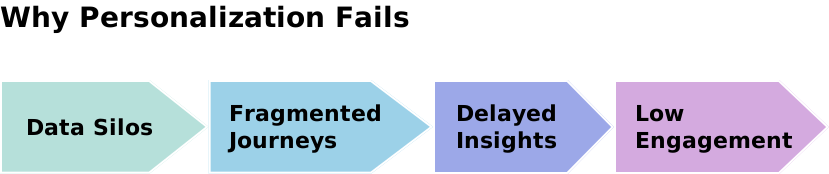
Why Fragmented Journeys Hurt More Than Engagement Metrics
- Fragmentation doesn’t just reduce clicks. It impacts revenue, trust, and long-term growth.
Higher unsubscribe and opt-out rates
Lower conversion across channels
Wasted ad spend on irrelevant messaging
Slower funnel progression
Poor customer lifetime value
McKinsey estimates that companies delivering consistent, connected experiences grow revenue 10–15 percent faster than peers. Fragmentation does the opposite.
In competitive markets, customers leave without complaining
What a Connected Journey Actually Looks Like
- A connected journey adapts in real time. Each interaction builds on the last.
Example:
A website visit updates customer intent
Email content adapts automatically
Sales sees engagement history in CRM
Service agents view recent campaigns
Offers change based on lifecycle stage
This is not manual coordination. It’s system-driven orchestration. When implemented, this is where Salesforce Marketing Cloud shines.
Advantage+: Turning Salesforce Marketing Cloud into a Journey Engine
Salesforce Marketing Cloud is powerful. But power without structure leads to complexity. We help organizations move from campaign execution to full-scale marketing transformation with our Advantage+ Services using Salesforce Marketing Cloud as the foundation.
Advantage+ Is Built Around the Entire Marketing Lifecycle
Advisory & Strategy Development
We align business objectives with Salesforce capabilities. No tool-first decisions. Every journey maps to measurable outcomes.
Implementation & Configuration
Rapid, structured deployment tailored to your customer engagement model — B2B or B2C.
Creative & Design Services
Responsive email templates, landing pages, and journey assets designed for consistency across channels.
Quality Assurance & Optimization
End-to-end testing across devices, channels, and scenarios before launch.
Integration & Data Readiness
We connect Marketing Cloud with Sales Cloud, Service Cloud, CRM, ERP, and third-party platforms — eliminating silos.
Post Go-Live Support & Analytics
Ongoing optimization, training, and analytics ensure continuous ROI and performance improvement.
How Advantage+ Solves Fragmentation
- Here’s what changes when journeys are connected:
Single customer view across systems
Behavior-driven journeys instead of static campaigns
Real-time triggers and personalization
Unified marketing, sales, and service context
Scalable automation without losing relevance
Personalization stops being fragile and starts being repeatable.
Who Benefits Most from Advantage+ Services
B2B organizations with long buying cycles
B2C brands managing multi-channel engagement
Enterprises struggling with low campaign ROI
Teams migrating or optimizing Marketing Cloud
Businesses aiming to operationalize personalization
If personalization feels complex, inconsistent, or hard to scale, Advantage+ brings structure.
When data connects, systems align, and journeys adapt in real time, engagement follows naturally. With the right foundation and execution model, Salesforce Marketing Cloud becomes more than a campaign tool; it becomes the engine for meaningful customer relationships. Rialtes help organizations harness the power of Salesforce Marketing Cloud with our Advantage+ Services. Ready to Accelerate Your Marketing? Let’s Talk!
FAQs: Fragmented Customer Journey
Latest Blogs