



Why ERP Transformation Challenges Are Forcing Enterprises to Rethink Their Strategy
ERP modernization has been on boardroom agendas for years, yet success stories are still far fewer than expected. Leaders know transformation is necessary, but the path often turns bumpy. Gartner reports that 55 percent of ERP projects fail to meet their original business case, while McKinsey notes 70 percent of digital transformation efforts stall or fail to scale beyond pilots. The reasons repeat themselves: legacy technical debt, customizations that lock flexibility, ballooning implementation costs, and a slow crawl toward business value.
Enterprises are now asking the right questions.
Not “Should we modernize?”
But “How do we transform without repeating the mistakes of the last decade?”
This shift in mindset is prompting organizations to reassess their ERP strategy, move beyond fragmented upgrades, and seek a guided, outcomes-driven approach. That’s exactly where RISE with SAP becomes an inflection point.
The Legacy ERP Problem No One Can Ignore Anymore
- Many ERP systems did their job well in their time. They maintained structured, controlled, and compliant processes. But business today moves differently, faster, interconnected, data-rich, and AI-driven.
Legacy ERPs struggle here, and these are the symptoms
Every new integration feels like a patchwork job
Reporting takes days because data lives in silos
Customizations break during upgrades
Teams rely on spreadsheets to compensate for system gaps
Innovation plans get stuck behind technical constraints
A system built for yesterday slows down a business built for tomorrow.
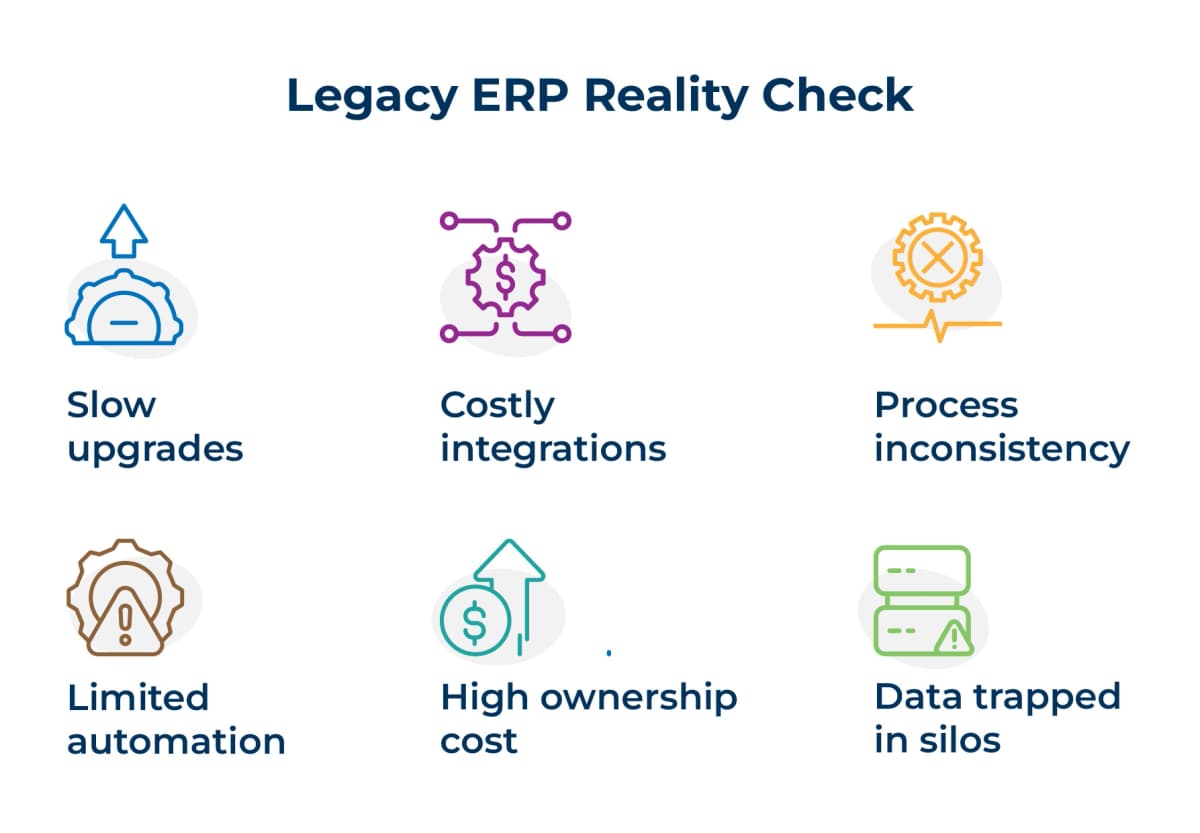
This stagnation is expensive. IDC estimates global businesses lose trillions annually due to process inefficiencies and outdated systems. Enterprises cannot compete with agility if their core runs like it’s still 2008.
Why ERP Transformations Fail
- When transformation doesn’t land, it’s rarely the software. It’s execution, governance, and the mindset driving modernization.
- The common failure patterns look like this:
1
Over-customization that kills flexibility
Enterprises replicate old processes instead of adopting standardized best practices. This makes upgrades painful, expensive, and risky.
2
Scope creep and cost overruns
Projects start with clarity but grow beyond control. Without guardrails and governance, timelines expand, and budgets stretch.
3
Technology-first, business-second
Implementations often focus on IT migration instead of value creation. The outcome? New system, same old inefficiencies.
4
Change management as an afterthought
Employees resist new processes when they don’t understand the ‘why’. User adoption becomes the biggest roadblock.
Why ERP Projects Fail Over-customization
Scope creep
Tech-first mindset
Low adoption
The lesson here is practical: transformation needs structure, not just software licenses.
RISE with SAP: A Smarter Way to Transform, Not Just Replace ERP
- RISE with SAP was built to solve this exact enterprise challenge.
- It’s a business transformation as a service model, combining SAP S/4HANA Cloud, infrastructure, tools, accelerators, and support in one package. Instead of navigating ERP modernization alone, enterprises get a managed, guided, and outcome-oriented journey.
What makes RISE different?
Single contract for ERP, cloud, infrastructure, and tools
Clean core approach reduces customization drag
Faster time-to-value with fit-to-standard adoption
AI-ready foundation with SAP BTP extensibility
Built-in automation, analytics, and continuous innovation
Upgrade-safe architecture built for long-term agility
Businesses aren’t just installing software. They’re future-proofing operations.
How RISE with SAP Helps Enterprises Break Out of Legacy Gravity
Let’s look at what transformation feels like when executed right.
Migrate to SAP S/4HANA with confidence
Enterprises get a clear roadmap from assessment to go-live. Legacy complexity is untangled, processes are rationalized, and the move is structured instead of chaotic.
Run on a clean core instead of customization-heavy ERP
Adopting industry best practices reduces code debt and keeps future upgrades effortless. No more ten-year build-up of brittle workflows.
Automate instead of firefight
With embedded AI, workflows, and analytics, teams spend less time fixing problems and more time improving performance.
Innovate continuously
Quarterly updates bring new automation features, compliance capabilities, and intelligence enhancements without downtime.
RISE with SAP = Migration + Innovation + Acceleration
- One contract, one platform
- Standardized processes
- Automation & analytics baked in
- Evergreen cloud ERP
Where RISE with SAP Fits Best
- This isn’t just for IT modernization. It’s for organizations aiming to build business advantage.
- Perfect for:
Enterprises planning a full digital core modernization
Organizations with heavy customization debt
Global firms requiring standardization across regions
Companies preparing for AI, automation, BTP extensions
Businesses are tired of high upgrade and maintenance cost
If transformation needs clarity and speed instead of uncertainty, RISE is the direction.
Business Outcomes That Matter to Leadership
- The real value shows up in result
Faster modernization versus multi-year ERP rebuilds
Lower operational and infrastructure overhead
Global process standardization and governance
Reduced maintenance and upgrade disruption
Improved reporting speed and decision confidence
Foundation ready for AI, automation, and data-driven growth
This is how enterprises break out of ERP stagnation and move toward continuous transformation instead of one-time migration.
How Rialtes Delivers Successful RISE with SAP Transformations
- Technology alone doesn’t guarantee outcomes; the partner doing the transformation does.
- At Rialtes, we help enterprises adopt and scale SAP S/4HANA through RISE with SAP with an approach built around governance, predictability, and measurable business deliverables. With certified consultants and multi-country delivery centers across the United States, Canada, India, and Singapore, we manage transformation end-to-end: from assessment to deployment to optimization.
Our methodology ensures success without chaos:
Discovery & Value Mapping
Identify pain points, maturity gaps, and business outcomes.
Fit-to-Standard Adoption
Use best practices instead of reinventing processes.
Clean Core Build & Data Migration
Keep systems stable, scalable, and integration-friendly.
Automation & AI Enablement
Introduce workflows, analytics dashboards, and self-service operations.
Continuous Improvement Model
Post-go-live support, KPI tracking, and innovation roadmap planning.
Rialtes RISE Delivery Model

FAQs: ERP Modernization with RISE with SAP
Latest Blogs