



How Can Manufacturers Improve Supply Chain Visibility with ERP, MES, and CRM Integration?
Manufacturers have no shortage of data. The challenge is that planning, production, and customer information often reside in separate systems. ERP manages orders and inventory, MES tracks shop-floor execution, and CRM captures customer commitments.
When these systems are disconnected, teams make decisions using different versions of the truth. Integrating ERP, MES, and CRM creates a shared operational view, helping manufacturers improve delivery performance, respond faster to disruptions, and align planning with execution.
What Is Poor Supply Chain Visibility?
Ask a plant manager, a supply chain planner, and a sales director the same question, 'Will this order ship on time?', and you will often get three different answers. Each is working from a system that is accurate for its own purpose. None of them is looking at the same picture.
That gap is what people usually mean by poor supply chain visibility. It is less about missing data than data stuck in separate places.
Connecting those three is one of the more practical ways a manufacturer can see its supply chain as it really is.
Visibility Is Still Hard When Every System Works
Most manufacturers do not lack systems. In Rockwell Automation's July 2026 report, Scaling MES Across the Enterprise, which surveyed 1,560 manufacturing and industrial operations decision-makers in 17 countries, 93% said they have an MES in place. Yet only 28% have deployed it enterprise-wide, and just 23% report full integration across ERP, PLM, quality, and operational technology. Integration was the top MES buying requirement (44%), and 33% named MES as their biggest data integration problem.
In short, the software is largely installed and the connections are not. That is why a planner can still be surprised by a line that has been down for three hours.
The split is long-standing. The ISA-95 standard, which defines how enterprise and plant systems should talk to each other, places the MES at Level 3 (manufacturing operations: scheduling, maintenance, execution) and ERP, supply chain, and CRM at Level 4 (business planning). The two levels run on different clocks: business systems think in days and weeks, the plant in minutes. Without deliberate integration, information crosses between them late, summarized, or not at all.
What Does Each System Contribute?
It helps to be clear about what each one owns before connecting them
| System | What it knows | What it usually cannot see |
|---|---|---|
| ERP | Orders, inventory, purchasing, costs, financials, planned schedules | Real-time machine status, quality holds, actual yield |
| MES | Work in progress, line status, downtime, scrap, genealogy, actual vs. planned output | Customer commitments, supplier delays, financial impact |
| CRM | Customer orders and forecasts, delivery promises, service history, account priority | Plant capacity, material availability, production status |
Each system is the authority on its own domain. Visibility comes from letting the answers meet, not from moving everything into one tool.
Connected Visibility in Practice
Take a common case
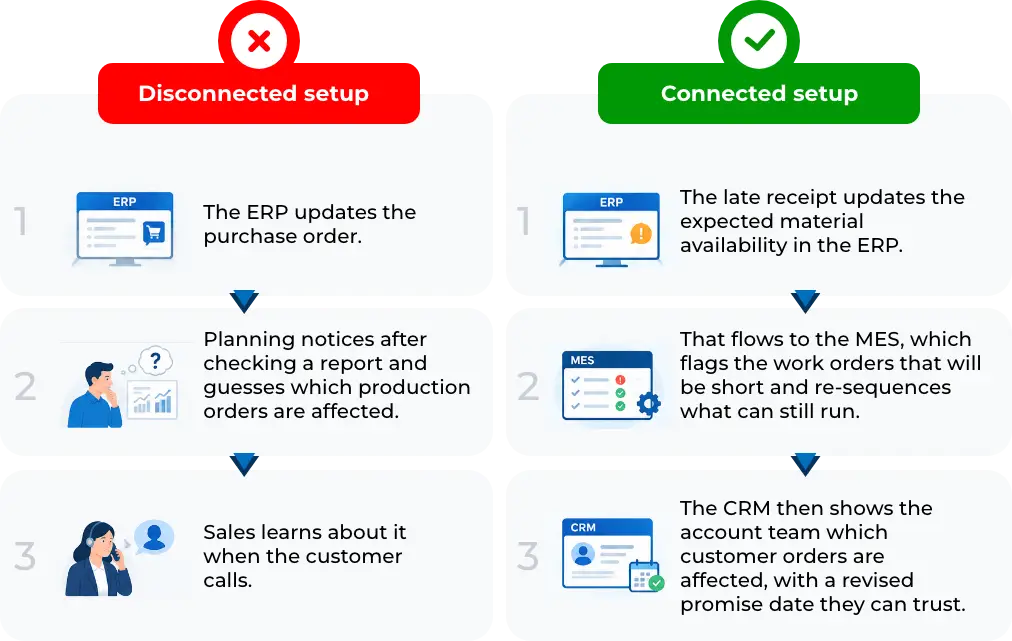
The logic also runs the other way. If the MES reports a quality hold or line stoppage, the effect on open customer commitments appears the same day, while there is still room to reschedule, expedite, or call the customer first.
With Salesforce Sales Cloud connected to ERP, a manufacturer cut order processing time so production could begin within 48 hours of design approval.
Where Should a Manufacturer Start?
Connecting everything at once is a common reason these programs stall. A more reliable approach starts with a few decisions.
Agree on shared master data.
Part numbers, bills of materials, routings, work centers, and customer and supplier IDs must mean the same thing in all three systems. Many problems that look technical turn out to be master data disagreements, so settle ownership of each record type before building interfaces.
Pick the questions that matter.
Instead of “integrate everything,” start with three or four questions leadership wants answered reliably: Which customer orders are at risk this week? What is the real inventory position, including work in process? Where are we losing time against plan? Build the data flows that answer those first.
Match the speed to the decision.
Not every connection needs to be real time. Financial postings can move in batches, while line stoppages, quality holds, and material shortages are worth sending as events when they happen. Real time everywhere adds cost without adding insight.
Respect the ERP and MES boundary.
The ERP should plan and the MES should execute. Pushing shop-floor logic into the ERP, or business planning into the MES, creates systems that are hard to maintain. A standard such as ISA-95 gives both sides a common vocabulary.
Show exceptions, not everything.
A planner who gets 4,000 alerts will ignore them. Visibility is only useful when it surfaces the handful of items that need a decision.
Three Issues Come up Repeatedly
Connecting everything at once is a common reason these programs stall. A more reliable approach starts with a few decisions.
When integration sits between IT, operations, and sales, nobody feels responsible for the whole. A single owner for end-to-end data flow, with supply chain and plant representation, often matters more than the choice of middleware.
Large manufacturers often run different MES products, or different versions, at different sites, sometimes inherited through acquisitions. A global rollout usually needs a common data model that each plant maps to, rather than a single rigid template.
A planner burned once by a wrong number will go back to the spreadsheet. Pilot on one product line or plant, reconcile the numbers openly against what people already believe, and expand once the data has earned confidence.
What Should Leadership Measure?
Look at the outcomes visibility is meant to change:
Promise-date reliability:
Time to detect and respond:
Manual reconciliation effort:
Expedite and premium freight costs:
Measure these before the integration and again after the first release. That comparison builds the case for the next phase.
Bringing It Together
Improving supply chain visibility rarely requires replacing a system. The more useful work is connecting the ones you already own, deciding who is the authority on what, and sending the right information to the right person at the speed the decision requires.
This is the kind of work Rialtes does with manufacturers every day. As a Salesforce and SAP partner, we connect ERP, plant, and customer data so that planning, production, and sales work from the same facts. Our SAP consulting and implementation services cover the ERP foundation, and our Salesforce consulting work brings customer and order context into the picture.
If your teams are still giving three different answers to the same question, that is a good place to start the conversation.
FAQs: Supply Chain Visibility in Manufacturing
Latest Blogs